Jo McNamara writes:
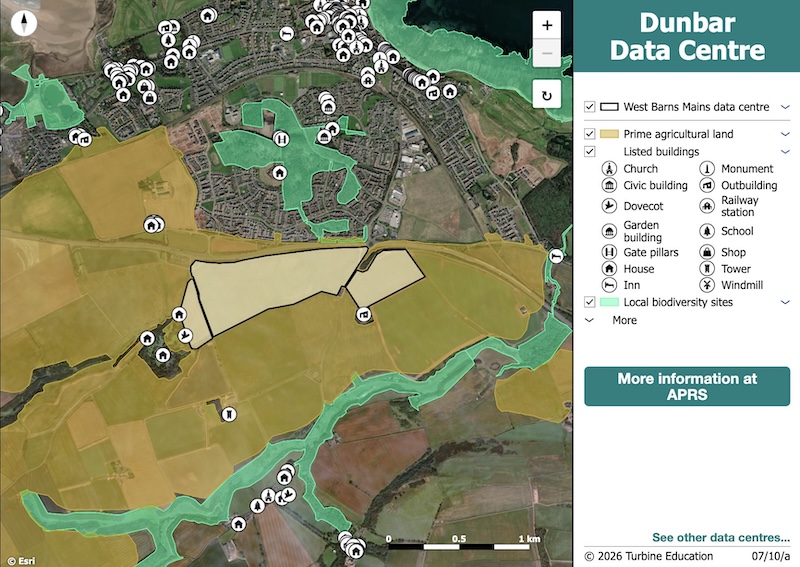
In late 2025 a newly formed company based in Glasgow, Thistle Sands Data Limited, presented a scoping paper to East Lothian Council outlining a proposal for construction of a massive data centre on a 60 hectare site of prime agricultural land just to the south of the A1, stretching from the Spott roundabout to the edge of West Barns. This is just 50m from homes in Muirfield Road and Home Avenue and would totally surround Wester Broomhouse Cottages.
This proposal was presented at a time when Scottish Government had no coherent strategy for data centre development and an outdated understanding of data centres that did not take into account the substantial increase in size and resource demands of current ‘hyper-scale’ data centres.
In common with the rash of other proposals being brought forward across central and southern Scotland, the Thistle Sands proposal seeks to position itself as a ‘Green Data Centre’ on the basis that it would use renewable energy, attempt to minimise energy and water use, feed waste heat into district heating and take measures to mitigate impacts on biodiversity, landscape and historic heritage.
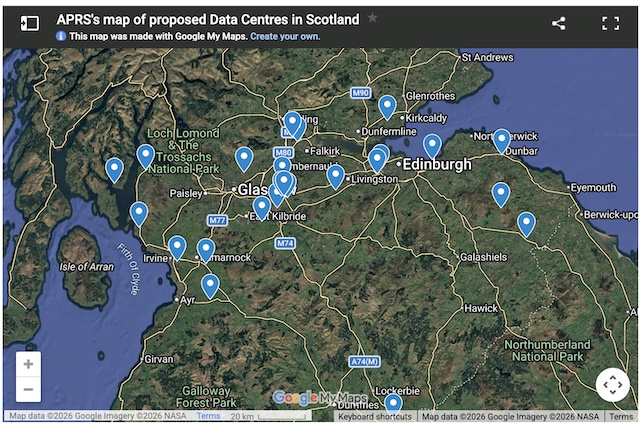
Since then communities affected, including Dunbar, have mobilised, generated campaigns, circulated petitions, participated in marches and joined forces with other organisations. Action for the Protection of Rural Scotland (APRS) has focused this energy by demanding a Scottish Government moratorium on development until fundamental issues have been addressed.
The demand was declined and instead a Motion passed that recommended that concerns should be addressed by producing guidelines within the next 12 months to inform planning decisions. In the meantime no planning consents should be granted. Despite this assurance APRS still has an open petition calling for the moratorium.
The Government response has not assuaged anxieties for the following reasons:
- Ministers stated that the moratorium was refused because it would send the ‘wrong signal’ to investors. They are reluctant to communicate with communities but are happy to entertain industry lobbyists and the guidelines will be developed with input from the company behind the largest Scottish proposals.
- Both Holyrood and Westminster assert that data centres are essential for economic prosperity and the inward investment attracted will create jobs and revitalise communities. The social and environmental impacts are of less concern in the face of this imperative.
- Discussion around these issues has intensified but our politicians still refuse to acknowledge the cumulative impacts of current and future developments, widespread concern that benefits are over stated and that the huge environmental implications and dangers of unconstrained development are underestimated.
- Financial investment is an indication of the scale of transactions and resource demands that underpin this technology. The American bank JP Morgan Chase estimates that $5,500,000,000,000 will be spent over the next three years to support this technology’s growth. Generating that stupendous sum will create devastating impacts on the natural systems on which we all ultimately depend. At local level this will be compounded even further by the on-going impacts of data centre operations.
If consideration is given to the whole life cycle, the carbon emissions and environmental impact generated by a data centre such as proposed for Dunbar are very significant, including:
- Its infrastructure requires substantial quantities of concrete, steel and other materials quite apart from the copper, silicon, lithium and critical minerals in all the IT equipment. The production and installation of these products have significant embodied greenhouse-gas emissions.
- Operational energy supply must be maintained and backup generators, usually diesel powered are used to ensure there is no shut down due to supply outage.
- This proposal gives no specific information about its energy demand but the computing power of centres on similar sites requires around 400 MW which over one year equates to roughly fifty times the current annual heat demand of all the houses in Dunbar.
- IT equipment has a limited life span and requires regular replacement. Discarded equipment wastes valuable metals that are hard to extract and creates a stream of toxic waste for disposal.
- At local level food security will be compromised through loss of productive agricultural land and water supply through demand and pollution.
- The Developers state that a closed loop system will minimise water requirements. However this approach involves the use of PFAs otherwise known as ‘forever chemicals’ for which there is no current safe disposal route.
- Every habitat lost or polluted further undermines levels of biodiversity
Local residents determined to avoid this eventuality have grouped together and set up Dunbar Against Massive Data Centres (DAMD) to campaign against this development.
Meetings have been well attended and a core group whose members have high levels of expertise in media and communications, relevant scientific disciplines, planning and community development has formed.
It is understood that digital technologies are now embedded in our lives and require data processing facilities but they believe this can be achieved from smaller, less damaging centres than the hyper-centre currently proposed.
The essential objective at this stage is to ensure that people across our community have a grasp of the issues and are sufficiently well informed to participate meaningfully in the planning process, as and when an application is finally submitted. This could take some time and, in the interim, sustaining commitment to the campaign is challenging but vital.
However, new and strong relationships are forming across the community, social and educational events are being planned and the campaign team is optimistic about this process.
Information about progress, how you can be involved and how you can help can be found on the Dunbar Against Massive Data Centre Facebook page.
DAMD will be joining the march to Holyrood on Saturday 14th November demanding a national conversation and a formal pause on planning decisions. A high turnout is important to show the strength of concern about these issues. We need a national conversation about the rollout of AI and data centres before any decisions are made. It is an issue that affects us all.
You can also follow how Action for the Protection of Rural Scotland supports local groups and works tirelessly to put pressure on Scottish Government to acknowledge the need for scrupulous assessment of the range of environmental impacts deriving from unconstrained development.
Their website gives details of actions you can take to support local and national campaigns.