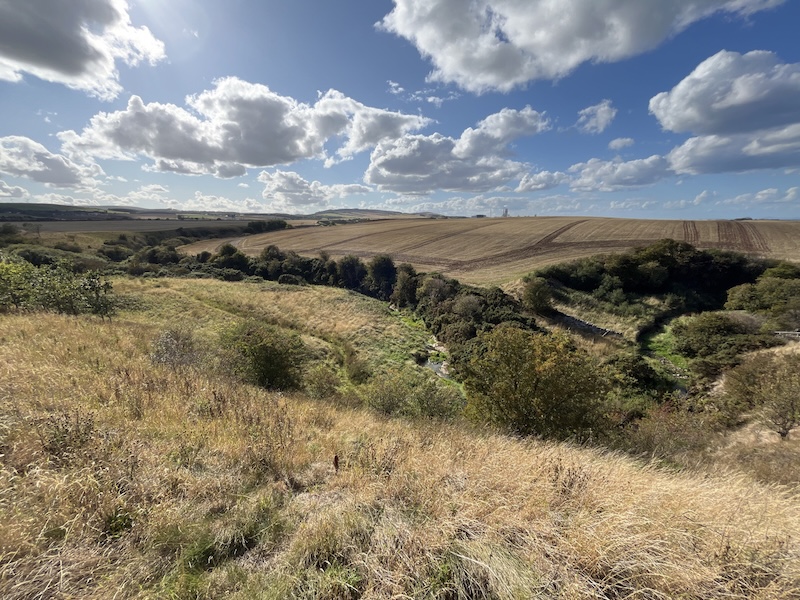
Our Summit to Sea river catchment restoration project is developing well, with strong local interest from residents and landowners across East Lammermuir. Our initial on-the-ground surveys of the four main East Lammermuir coastal burns and their tributaries, carried out over the past 18 months, have highlighted some of the key problems and pressures facing these burns as well as hundreds of potential opportunities for positive habitat restoration and enhancement measures.
Thanks to one year of ‘development’ funding from the Nature Restoration Fund, we have been able to appoint Jenny Gries as our ‘Catchment Restoration Development Officer’ who has been in post now since May. She has been very busy connecting with landowners, with an initial focus on the Spott and Dry Burn catchments, reporting on the findings from our previous surveys, discussing opportunities for collaboration and some of the key challenges they face with water management in the context of the increasing frequency of extreme weather. How can we slow water movement through the catchment, develop a more collaborative approach to water management and work together to help nature thrive and to re-vitalise our burns in particular?
To date, designs have now been prepared for initial enhancement and restoration projects on around 11 of the 22 landholdings in these two short coastal catchments. Discussions are continuing on landowner agreements and maintenance responsibilities for the restoration work that will start to be delivered in the next phase of the project. These projects range from riparian tree planting to creation of new wetlands, buffer strips, fencing livestock away from water courses, removal of barriers to fish migration and so on to hedgerow planting and restoration.
Our recent advisory group meeting in Spott Village Hall brought together around thirty people from a broad cross-section of the community, including farmers, residents, educators and local project partners, for an open and constructive conversation about the future of our burns, farmland and wildlife.
One of the clearest messages from the evening was the value of simply talking. Farmers and landowners spoke candidly about the pressures they face—particularly lack of time, uncertainty around future funding and schemes, and the confusion created by so many different organisations and projects approaching them. Several people emphasised that ongoing, trusted conversations are essential if we are to build confidence and find practical ways forward. As one participant put it, unless people speak, they do not know how others are thinking; these conversations can be the “stone in the pool” that creates wider ripples.
There was real interest in working at a catchment scale, while recognising that every farm and stretch of burn is different. Landowners shared their own experiences of change over the years, including moving to rotational grazing, reduced fertiliser use, changes in vegetation and wildlife, and the growing challenge of managing both too much water in sudden downpours and too little water in dry periods. Several people highlighted the importance of slowing and protecting water across the catchment, improving soil health, shading burns to keep water cooler, and finding the right intervention in the right place.
There was strong support for involving more people, particularly young people, in the project. Ideas included more walks and workshops, visits for residents, learning opportunities for schools. Several attendees also spoke about the value of connecting town and country, and of helping people understand that nature is present everywhere—even in urban settings—and that everyone can play a part in caring for it.
Looking ahead, we hope to build on this momentum by offering more opportunities to learn, share ideas and see catchment-scale restoration in practice. We are exploring another visit to the Eddleston Water Project in the New Year, which would give interested landowners the chance to see examples of natural flood management, river and habitat restoration, and long-term partnership working.
We are also excited to be able to announce that we have now secured support from the NnG Community Fund towards both the ongoing staff costs of our Development Officer and the technical support from Forth Rivers Trust as well as for an initial pot of capital funding for delivery some initial habitat restoration projects. This is hugely helpful in maintaining the momentum of the project, will enable us to extend development work the Oldhamstocks and Thornton Burn catchments and to start project delivery on the ground. It should also make it easier to secure matched funding from other sources to help in achieving our long-term project ambition to see nature restoration happening at landscape scale across our local area.
For further information, to input ideas or to discusss the project and explore ways to get involved, please contact jenny@sustainingdunbar.org